
The doctor uses the word "dementia" and the room goes very quiet. The family sitting around the table — a son who drove three hours, a daughter who flew in from Mombasa, a spouse who has been quietly watching something change for two years — each processes the word in their own way. Some feel relief that it has a name. Most feel fear about what comes next.
What comes next, for the majority of Kenyan families, is home care. Because in Kenya, as in most of Africa, the instinct to care for our elders at home is not simply cultural preference — it is love made practical. This guide is written to help your family do that well.
The diagnosis that changes everything
A dementia diagnosis rarely arrives cleanly. It comes after months — sometimes years — of small confusions: a name forgotten, a story repeated, a wallet lost for the fourth time this week, a person who drove the same road for thirty years and one day cannot find their way home. By the time a clinician makes the formal diagnosis, families have usually already been living with early dementia for some time. The diagnosis does not change the person. But it changes what the family now needs to do — deliberately, intentionally, and with support.
The first weeks after a diagnosis are often the hardest emotionally. There is grief — genuine grief for the person who is still present but changing. There may be conflict within the family about what to do next. There is almost always an urgent need for information. Start here.
What dementia is — and isn't
Dementia is not normal aging. It is not simply "getting old" or "being forgetful." It is a clinical syndrome caused by progressive damage to the brain — affecting memory, reasoning, language, orientation, and eventually the ability to manage daily activities and physical functions. It is caused by disease processes, the most common of which include:
- Alzheimer's disease: The most common cause of dementia, accounting for 60–70% of cases. Characterized by the gradual loss of memory for recent events, followed by language difficulties, disorientation, and changes in personality.
- Vascular dementia: Caused by reduced blood flow to the brain, often following strokes. May present in a more step-by-step decline rather than a gradual slope.
- Lewy body dementia: Associated with visual hallucinations, sleep disturbances, and significant fluctuations in alertness and attention.
- Mixed dementia: Many older adults have more than one type simultaneously.
According to Alzheimer's Disease International, approximately 55 million people worldwide are currently living with dementia — a number projected to rise steeply as global populations age. The majority live in low- and middle-income countries, and most are cared for at home by family.
The four stages families recognize
Clinical staging systems vary, but most families find it useful to think about dementia in four broad phases:
- Early stage: The person is largely independent. They may repeat questions, lose objects, struggle with complex tasks like managing finances or following a recipe, and occasionally become confused in unfamiliar environments. They are usually aware something is changing and may be frightened by it. Dignity is paramount in this stage.
- Moderate stage: Memory loss deepens and affects core daily functions. The person may not recognize familiar faces consistently. They may become anxious, agitated, or emotionally unpredictable. They need supervision and regular support for activities like bathing, dressing, and eating. This is the stage in which most caregivers begin to feel exhausted.
- Severe stage: The person requires full assistance for all activities. Communication becomes very limited. Physical complications — swallowing difficulties, incontinence, increased vulnerability to infection — become prominent. The caregiving load at this stage requires either professional support at home or a skilled nursing facility.
- End-of-life: The body is shutting down. Care at this stage is palliative — focused on comfort, dignity, pain management, and the presence of family. This is a sacred time. It should look the way the family needs it to look.
Building a dementia-friendly home
The home environment can either reduce or amplify distress for a person living with dementia. These practical adjustments make a measurable difference:
- Labeled rooms and objects: Simple printed labels on doors, drawers, and containers (in the person's primary language — Kikuyu, Dholuo, Swahili) reduce confusion and preserve independence.
- Simplified daily routines: Predictable routines reduce anxiety. Wake, wash, eat, rest, activity, eat, rest, sleep — in the same order, at roughly the same times.
- Remove tripping hazards: Loose rugs, electrical cables across walkways, and furniture in unusual positions all increase fall risk significantly. Clear, wide pathways are essential.
- Motion sensors and door alarms: To alert the family if the person leaves the home during nighttime hours — a common wandering pattern.
- Secured medication: All medications — including over-the-counter drugs — should be locked away. A person with dementia cannot reliably manage their own medication safely.
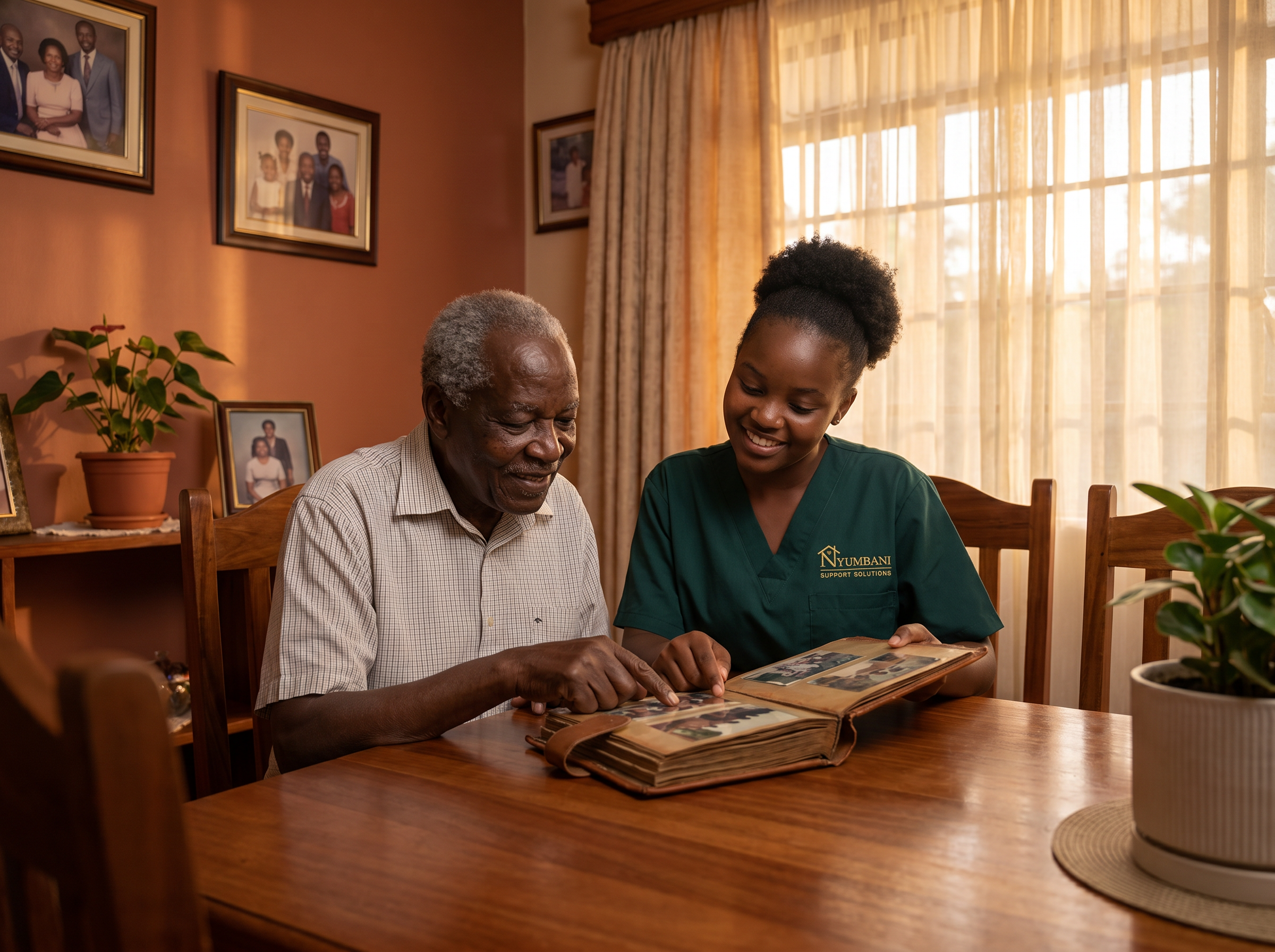
- Photo cues: Framed photographs with names and relationships written underneath help orient and comfort the person when language and memory are unreliable.
The behaviors that scare families — and what they actually mean
Dementia causes behaviors that can be deeply distressing for families who do not know what to expect. Understanding them as communication — rather than as misbehavior or deliberate cruelty — changes everything.
- Sundowning (increased confusion and agitation in the late afternoon and evening): This is neurological, not intentional. Calm lighting, reduced noise, and a settled routine help.
- Repetitive questions: The person is not asking to irritate you. They genuinely cannot retain the answer. Respond warmly each time, or redirect gently.
- Accusations: "You stole my money." "You are not my family." These are painful to hear and almost never personal. The brain is searching for explanations for experiences it cannot process. Do not argue.
- Wandering: Often driven by a need — to find the toilet, to follow a remembered routine, to find safety. Addressing the underlying need matters more than stopping the movement.
- Refusing food or bathing: Fear, pain, loss of recognition, or simply not understanding what is being asked. Approach quietly, explain simply, and allow as much autonomy as the situation safely permits.
Communication that works
The way you speak to a person with dementia matters as much as what you say. These approaches work:
- Use short, simple sentences — one idea at a time
- Maintain eye contact and approach calmly from the front
- Validate their emotional reality rather than correcting their facts
- Use familiar names — "Mama" rather than a first name they may no longer recognize
- Speak in their most comfortable language — for many elders, this means returning to their mother tongue: Kikuyu, Dholuo, Luhya, Kamba, or Swahili. The heritage language is often the last to go and the most deeply comforting
- Do not rush. Silence is not a gap to fill — it is time for the person to process
"I used to argue with my mother. I would tell her, 'It is me, your son.' Now I just sit with her. I let her tell me about her brother who died in 1972 as if he was at the door. She is happier. So am I." — A Nyumbani client's son, Kiambu
When live-in support becomes essential
Most families reach a point where the existing arrangement — family members rotating visits, a neighbor checking in, a domestic worker who helps with meals — is no longer sufficient. The moment is often missed until a crisis occurs: a fall, a fire left unattended, a medication error, or a family caregiver who simply collapses from exhaustion.
The indicators that live-in or daily professional support has become necessary include: the person requires supervision at night; they can no longer be left alone safely for any period; physical care needs (bathing, continence, wound care) exceed the capacity or training of the family; or the family caregiver is showing signs of severe burnout or health deterioration themselves. Seeking help at this point is not failure. It is the right decision, made for everyone's dignity.
Caring for the caregiver
Behind every person living with dementia is at least one person — usually a daughter, a daughter-in-law, or a spouse — who is quietly absorbing an enormous amount of emotional and physical labor. That person deserves care too. In our next article in this series, we look closely at caregiver burnout: what it is, what it costs, and what actually helps. If you are that person, please read it.
This article is for general educational purposes and does not replace individualized advice from a qualified clinician, geriatrician, or neurologist. If you are concerned about a loved one's cognitive health, please consult a medical professional for formal assessment and diagnosis. Care plans should always be developed in consultation with the treating clinician.
Considering home-based dementia support?
Nyumbani Support Solutions provides trained, compassionate live-in and visiting care for Kenyan families navigating dementia at home.
Book a Consultation