
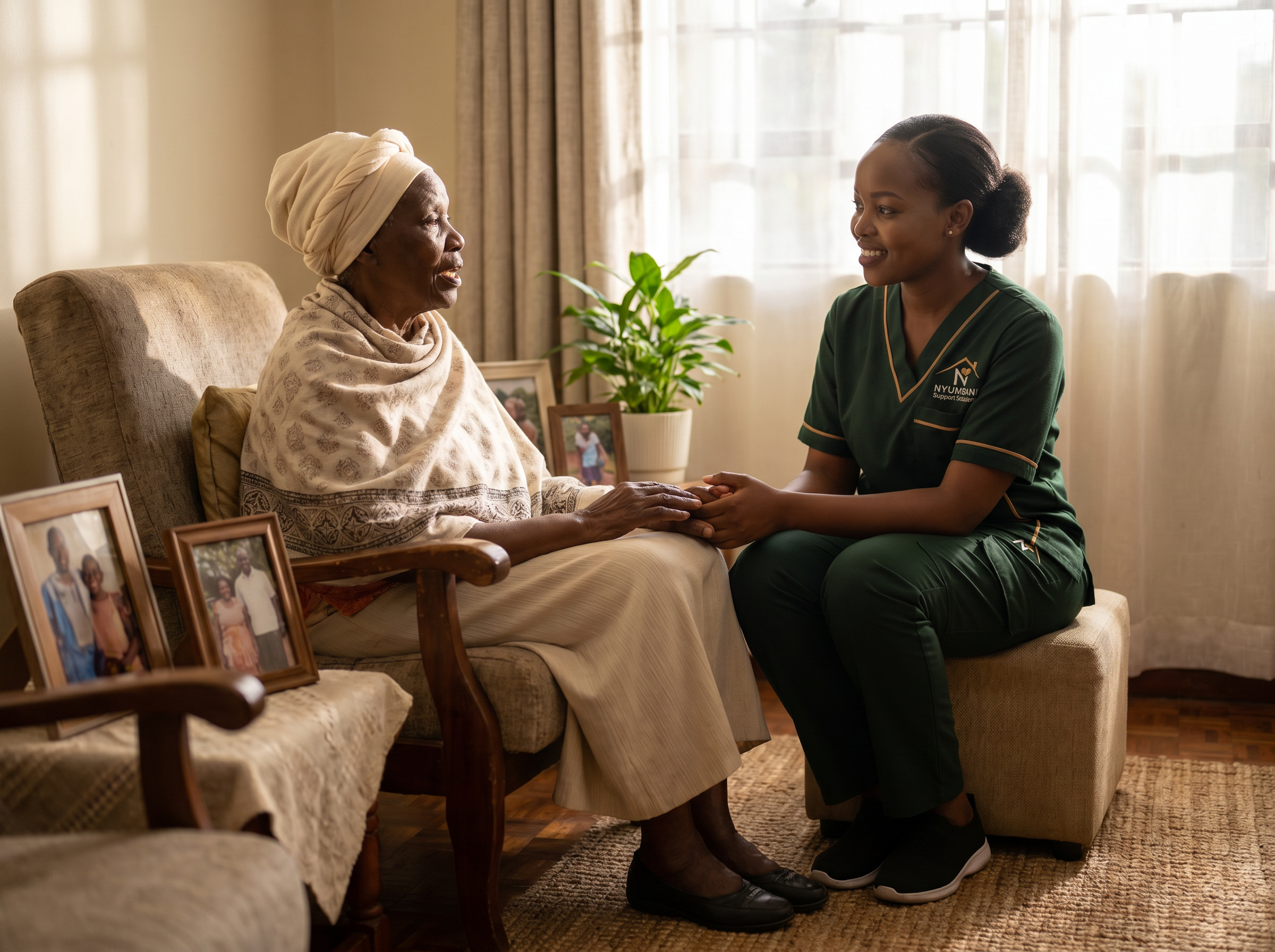
I spend a lot of time on the phone with Kenyan-American families in the United States who are trying to figure out how to care for an aging parent back home. The conversations almost always begin the same way: a thick exhale, a long pause, and then some version of the same sentence — "I just don't know what to do."
Underneath that hesitation is usually a quiet collection of myths about what home care is, who it's for, and what it says about a family. Most of these myths are decades old. Most of them are wrong. And every one of them is keeping our elders from the care they deserve.
Myth #1: "Hiring a caregiver means we don't love our parents enough"
This is the heaviest one — and the one I hear most often. In many African cultures, the responsibility of caring for an aging parent has long fallen on the children, particularly daughters and daughters-in-law. There is real beauty in that inheritance. But there is also real pain when families confuse the commitment to care with the delivery of care.
Hiring a trained caregiver doesn't replace your love. It expresses it. A skilled nurse who can manage your father's diabetes, monitor his blood pressure, recognize the first signs of a stroke, and help him walk safely to the bathroom at 3 a.m. is not replacing you. She is doing what you cannot safely do from your office in Dallas, your shift at a Nairobi hospital, or your seat in a graduate program in London. Modern care is a partnership, not a betrayal.
"I felt so guilty when we first hired a caregiver for Mama. Now I see — she has gained weight, she laughs again, she calls me to gossip. The caregiver gave me back my mother. I just had to let go of my pride." — A Nyumbani family, Mombasa
Myth #2: "Home care is only for people who are dying"
This is one of the most damaging assumptions, because it turns the words "home care" into a death sentence in many families' minds. Home care has become a hospice substitute in the cultural imagination — so families wait until things are catastrophic to call.
In reality, the families who get the best outcomes from home care call us early. Common situations where home care dramatically improves quality of life and prevents hospitalizations:
- An elder who has fallen once and is now afraid to walk alone.
- A parent with diabetes whose medication schedule has become unmanageable.
- A grandmother recovering from a hip replacement.
- A father in early-stage dementia who needs gentle companionship and routine.
- A patient just discharged from the hospital after pneumonia.
The earlier we step in, the more we can prevent. Hospice and palliative care are one service line we offer — they are not the meaning of home care.
Myth #3: "Caregivers are just untrained people who sit and watch TV with my parent"
This myth is unfortunately rooted in real experiences. Across Kenya, the informal caregiver market has historically been unregulated — full of well-meaning but untrained people who learned on the job, with no medical background and no oversight.
That is not what professional in-home care looks like. At Nyumbani Support Solutions, every caregiver is:
- Vetted — background-checked, reference-verified, and interviewed by our care team.
- Trained — minimum certification in basic nursing skills, first aid, dementia awareness, infection control, and patient dignity.
- Supervised — every case has a designated registered nurse who reviews the care plan and checks in weekly.
- Accountable — daily care notes, family communication, and incident reporting protocols.
If your caregiver is genuinely "just watching TV" — that is not home care. That is something else, and we would be happy to show you the difference.
Myth #4: "Home care is too expensive for normal Kenyan families"
This is a fair concern — and it requires honesty. Skilled, professional home care does cost money. So does a hospital stay, an emergency room visit, a missed week of work, a pressure ulcer that develops because no one was repositioning your father, or a fall that breaks a hip.
The real conversation is about total cost of care over a year — not the hourly rate of a single service. Many families discover that structured home care actually costs less than the alternative: repeated hospitalizations, missed wages, and the immeasurable cost of a family member burning out.
Nyumbani offers flexible service tiers — from 4-hour daily visits to live-in care, from skilled nursing to companion-only support — designed so that families can match the level of care to the level of need, without paying for what they don't require.
Myth #5: "Our elder won't accept a stranger in the home"
This concern is genuine, and it deserves a thoughtful answer. The wrong caregiver will absolutely be rejected by your parent — and rightly so. But the right caregiver, matched well, will not stay a stranger for long.
At Nyumbani, our matching process intentionally considers:
- Language — does the caregiver speak the elder's mother tongue? (Kikuyu, Luo, Kalenjin, Luhya, Kamba, Swahili, etc.)
- Cultural fit — religious background, regional familiarity, dietary norms.
- Personality — quiet and patient for some patients, more lively for others.
- Trial visits — we never lock a family into a long-term contract before the caregiver and patient have spent time together.
If the match isn't right, we change the match. No questions, no pressure. The elder's comfort is the whole point.
The real question
The conversation about home care is not really about home care. It is about what kind of life we want for our elders, what kind of family we want to be, and whether we are willing to evolve our ways of caring to match the realities of modern life — without losing the love at the center.
If you are wrestling with any of these myths, I would genuinely love to talk. No sales pitch. Just a real conversation about your family's situation.
This article is for general informational purposes only and does not constitute medical, legal, or financial advice. Care decisions should always be made in consultation with the patient's physician and family. Service availability and pricing may vary by location.
Considering home care for a loved one?
Nyumbani Support Solutions delivers dependable, dignified care at home, anywhere in Kenya. Diaspora-friendly coordination from our Dallas office.
Book a Consultation