
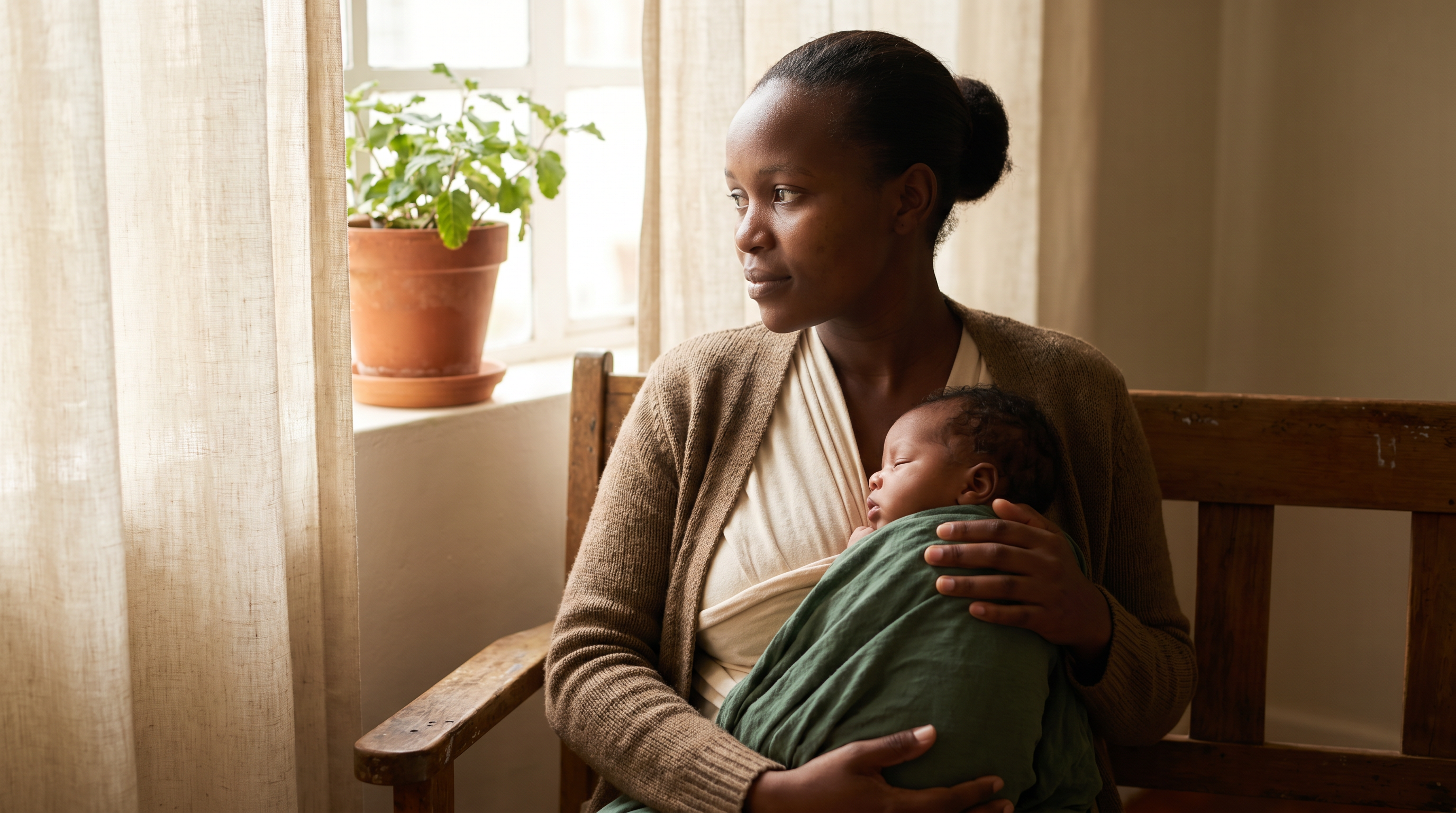
There is a particular kind of silence that settles over a Kenyan household after a baby is born. It is not the silence of peace. It is the silence of everyone waiting to see whether the mother will be strong enough — and then praising her when she appears to be, whether she truly is or not.
That silence has cost us more than we know. And it is time to gently, respectfully break it.
The silence we inherited
In many East African families, the "strong African mother" is not just an ideal — she is the expectation. A woman who has just given birth is expected to be grateful, capable, warm, and composed. Grief, fear, rage, and despair are emotions that belong to crisis — not to motherhood. And because expressing those feelings risks being labeled as ungrateful, unstable, or spiritually weak, many mothers learn very quickly to say "Niko sawa" — I am fine — even when they are not fine at all.
This silence is not weakness. It is an adaptation to a cultural environment that has not yet built enough language — or enough safe space — for maternal suffering. Naming it is not criticism. It is the first step toward changing it.
Among diaspora families, the silence is often compounded: a mother in Nairobi at least has her mother-in-law checking in. A mother in Manchester, Toronto, or Houston may have nobody within a twelve-hour flight who truly knows her history, her family, her language — or who will notice when something is wrong.
What perinatal mental health actually means
The term "perinatal" spans pregnancy through approximately twelve months after birth. Perinatal mental health conditions are not one thing — they are a spectrum of experiences that can emerge at any point during that window, and they include:
- Postpartum depression (PPD): Persistent sadness, emptiness, loss of pleasure, or inability to bond with the baby lasting more than two weeks after birth.
- Perinatal anxiety: Overwhelming worry, physical tension, panic attacks, or constant fear that something will happen to the baby — sometimes more common than PPD and often missed.
- Perinatal OCD: Intrusive, unwanted, often violent thoughts about the baby that horrify the mother. She is not a danger — she is suffering.
- Perinatal PTSD: Flashbacks, hypervigilance, and avoidance following a traumatic birth experience, pregnancy loss, or prior trauma.
- Postpartum psychosis: Rare but a genuine medical emergency. Rapid-onset confusion, hallucinations, or delusions, usually within the first two weeks. Requires immediate clinical intervention.
The World Health Organization estimates that approximately 1 in 5 women in low- and middle-income countries experiences a perinatal mental health condition — making it one of the most common complications of childbearing. It is not rare. It is not a sign of a bad mother. And it does not resolve on its own simply by telling a woman to be strong.
Why African mothers are uniquely vulnerable
African mothers — whether at home in Nairobi, Mombasa, or Kisumu, or raising children far from family in the diaspora — face a specific set of compounding pressures that mainstream perinatal mental health research has historically underexamined.
- Distance from family of origin: When the grandmother who would have come to help is in another county or another country entirely, the mother is left to absorb the shock of a newborn alone.
- Financial pressure: Short or non-existent maternity leave, coupled with the cost of newborn care, creates financial anxiety that intersects painfully with postpartum hormonal shifts.
- Urban isolation: Nuclear-family living in high-rise apartments in Nairobi is a world away from the communal compounds of previous generations. There is no one knocking at the door at 7 a.m. with a pot of uji.
- Pregnancy and infant loss: Miscarriage, stillbirth, and neonatal death carry a profound grief that is often silenced in our communities — treated as something to "move past" rather than something to mourn fully. Unprocessed grief is a significant risk factor for perinatal mental health conditions in subsequent pregnancies.
- The return-to-work squeeze: Many Kenyan mothers in formal employment return to demanding jobs within 90 days — often still physically recovering and breastfeeding, with fragile sleep and unaddressed emotional needs.
Warning signs families should know
Perinatal mental health conditions are treatable. The barrier is almost always recognition. These are the signs that should prompt a conversation — not alarm, but a genuine, gentle question:
- Persistent sadness, emptiness, or tearfulness lasting more than two weeks
- Loss of interest in the baby, or feeling disconnected or numb toward the newborn
- Intrusive thoughts (about harm coming to the baby, even if the mother would never act on them)
- Rage — sudden, intense anger that feels out of proportion, often directed at the partner or older children
- Refusing to sleep even when the baby sleeps, or inability to sleep despite exhaustion
- Inability to eat, or eating compulsively as a way to manage distress
- Social withdrawal — avoiding friends, family, WhatsApp groups, church
- Expressions of hopelessness, worthlessness, or thoughts that the baby or family would be better off without her
- Any thoughts of self-harm
If you are reading this list and recognizing yourself — or someone you love — please do not close this tab. Keep reading.
The Edinburgh Postnatal Depression Scale (EPDS)
The Edinburgh Postnatal Depression Scale is a validated ten-question screening tool developed specifically for the postpartum period, and it is now recommended as a standard of care by the American College of Obstetricians and Gynecologists. At Uzazi, we administer the EPDS at every postpartum home visit — not once, but repeatedly across the full 40-day window and beyond, because perinatal mental health conditions can emerge at any point, not only in the first days. If a mother scores above the clinical threshold, she is not judged. She is supported, referred appropriately, and held with both careful attention and human warmth. You can find the Edinburgh Postnatal Depression Scale online as a starting point for self-reflection, though a clinical conversation always follows.
"She kept telling me she was fine. I am her husband. I should have known. We had to lose almost three months before someone — her doula — asked the question no one else thought to ask." — A client's husband, Kiambu
What good care looks like
At Uzazi Wellness Care, our approach to perinatal mental health is grounded in routine, not exception. Every mother in our care receives mental health screening as a standard part of every postpartum visit — not as an add-on, and not only when she raises a concern herself. We know she will not always raise it.
Our postpartum care model includes:
- Routine EPDS screening at multiple points across the first 40 days
- In-home emotional support — visits structured to give mothers space to speak honestly, not just report symptoms
- Partner coaching — teaching husbands, mothers-in-law, and other household members what to watch for and how to ask the right questions without shame or alarm
- A clear referral pathway to Kenyan mental-health clinicians — psychologists, psychiatrists, and counselors — who understand the cultural context our mothers are navigating
- Follow-up coordination with the obstetrician or facility where delivery took place
We do not diagnose. We do not replace clinical care. But we are often the only consistent, trusted presence in a mother's home — and that position carries a responsibility we take seriously.
To the partner, mother-in-law, or sister reading this
You love her. You can see something is different, even if she insists she is fine. You may not know what to say, and so you say nothing — waiting for her to come to you, not realizing she is waiting for you to ask.
Ask her. Not "are you okay?" — she will say yes. Ask: "What is the hardest part of today for you?" Ask: "What do you need from me that you haven't been getting?" Ask it more than once. Ask it without your phone in your hand. Ask it in a quiet moment when the baby is asleep and there is nowhere to rush to.
And if what she tells you surprises you — if it frightens you — please reach out to us. We can help you understand what you're hearing, and we can help her get the right support.
This article is for general educational purposes only and does not constitute clinical diagnosis or treatment advice. If you or someone you know is experiencing thoughts of self-harm, harm to the baby, or any psychiatric emergency, please contact your clinician, a trusted hospital, or local emergency services immediately. In Kenya, the Befrienders Kenya helpline can be reached at +254 722 178 177.
Need maternal mental health support?
Uzazi Wellness Care provides routine perinatal mental health screening, in-home support, and referral pathways for Kenyan mothers and families.
Book a Consultation